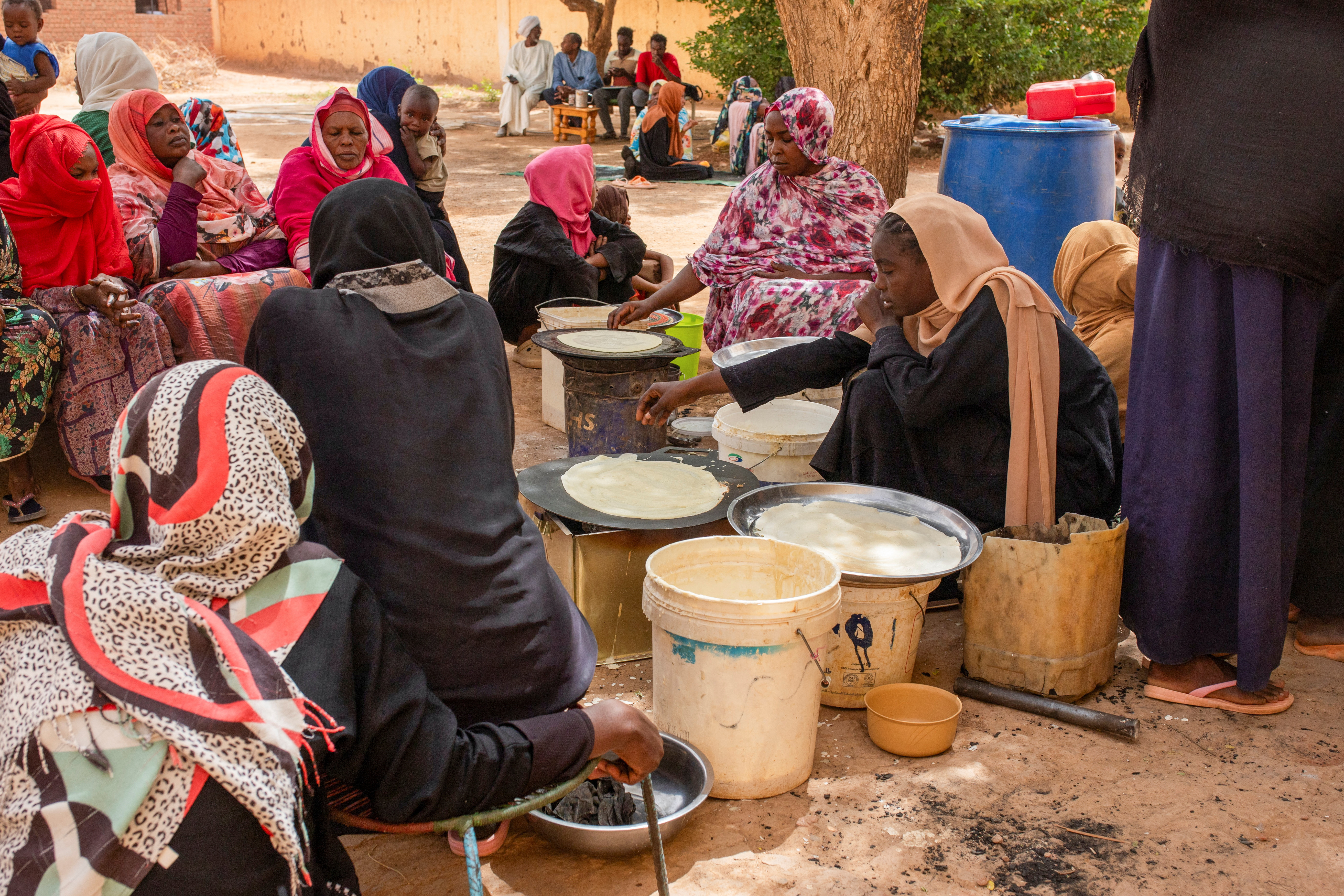
Sudanese women from community kitchens, run by local volunteers, prepare meals for people who are affected by conflict and extreme hunger and are out of reach of international aid efforts, in Omdurman, Sudan, May 13, 2024. REUTERS/Mazin Alrasheed/File Photo LONDON, Oct 23 (Reuters) – Nearly half of Africa’s citizens live in a country where governance has worsened over the past decade, as deteriorating security erodes progress, according to a new report.The annual Ibrahim Index of African Governance report found that despite positive progress in 33 countries, overall governance was worse in 2023 in 21 countries, accounting for just under half of Africa’s population, compared with 2014.For several countries, including densely populated Nigeria and Uganda, the deterioration in overall governance had worsened over the second part of the decade, according to the report released by Sudanese-British billionaire businessman Mo Ibrahim’s foundation.”We can see really a huge arc of instability and conflicts and this deterioration, and security and safety of our people, is the biggest driver of deterioration and governance…putting everything down in general,” Ibrahim told Reuters in an interview.Ibrahim pointed to the coups in West Africa and war in Sudan, but said poor governance also fostered violence and instability.”If there is deterioration on governance, if there is corruption, if there is marginalization…people are going to pick up arms,” he said.The report found that infrastructure – from mobile phone access to energy – and women’s equality, were better in 2023 for roughly 95% of Africans.Health, education and business environment metrics had also improved continent-wide.But the report found that public perceptions on progress were grim, even when the corresponding governance dimensions showed progress; all public perception indicators, apart from those tracking women’s leadership, declined.The worst drops were in perceptions of economic opportunities and of safety and security.The foundation said this could be due to higher expectations in countries that were making progress, and also a tendency to focus on what is not working.But Ibrahim said it was a serious problem.”If public dissatisfaction is high, that obviously can lead to unrest, it can lead to increased migration, conflicts,” he said.Reporting By Libby George; Editing by Sharon SingletonOur Standards: The Thomson Reuters Trust Principles.Libby George is a London-based journalist on the Reuters emerging markets team. She was part of a team named as Pulitzer finalists in 2023, and who won the Selden Ring Award for International Investigative Reporting, for a series of stories revealing abuses by Nigeria’s military. After launching her career as a political journalist in Washington, D.C., she joined Reuters in 2015 covering oil, and from 2019-2023, she was senior correspondent and acting bureau chief based in Lagos, Nigeria.

 English