Mars: Perseverance (Mars 2020)
Perseverance Home
Mission Overview
Rover Components
Mars Rock Samples
Where is Perseverance?
Ingenuity Mars Helicopter
Mission Updates
Science
Overview
Objectives
Instruments
Highlights
Exploration Goals
News and Features
Multimedia
Perseverance Raw Images
Images
Videos
Audio
More Resources
Mars Missions
Mars Sample Return
Mars Perseverance Rover
Mars Curiosity Rover
MAVEN
Mars Reconnaissance Orbiter
Mars Odyssey
More Mars Missions
The Solar System
The Sun
Mercury
Venus
Earth
The Moon
Mars
Jupiter
Saturn
Uranus
Neptune
Pluto & Dwarf Planets
Asteroids, Comets & Meteors
The Kuiper Belt
The Oort Cloud
2 min read
Margin’ up the Crater Rim!
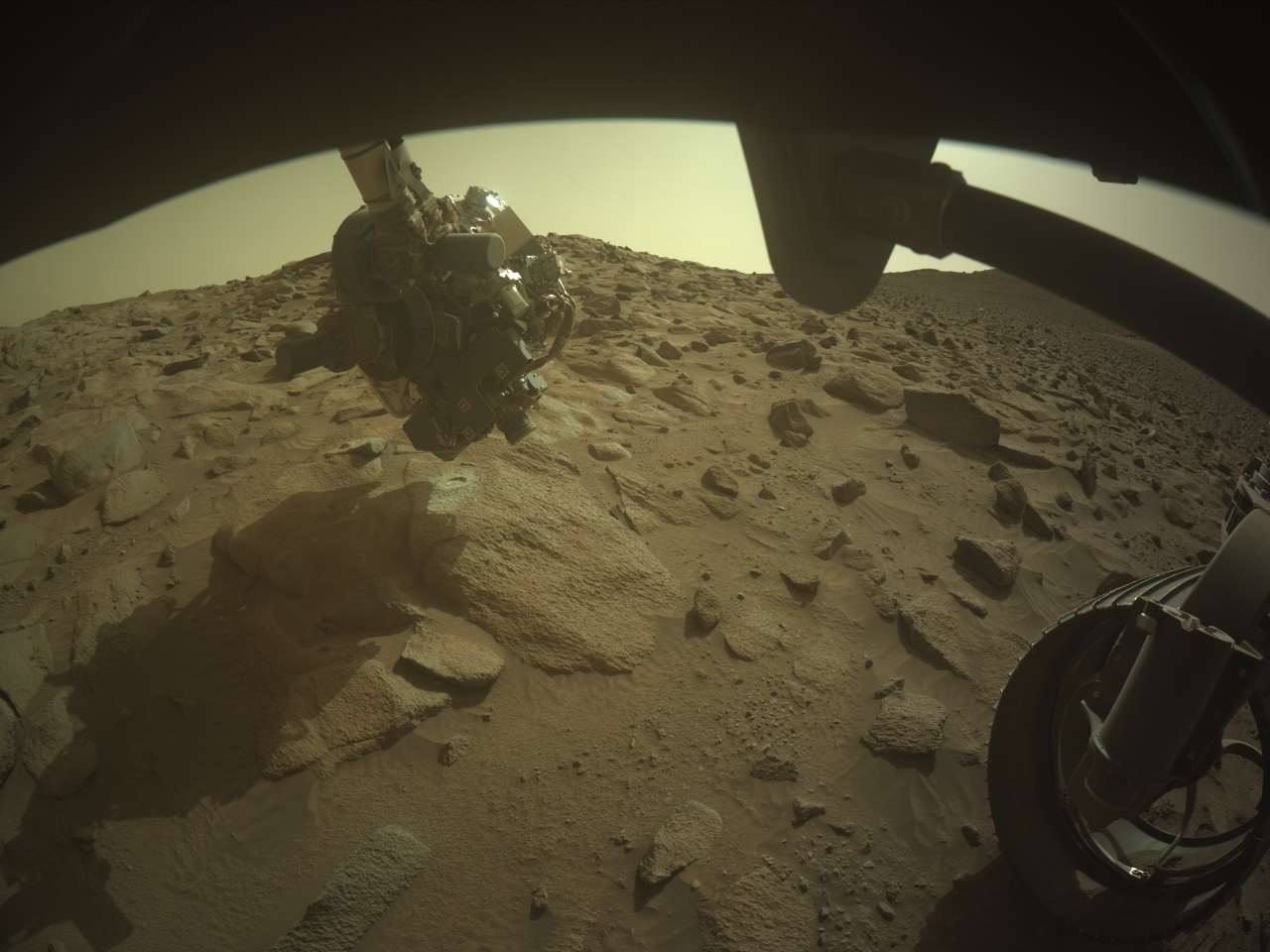
NASA’s Mars rover Perseverance conducts proximity science on the Eremita Mesa abrasion patch in the Margin Unit on Sept. 6, 2024, as it continues its traverse up the rim of Jezero Crater. Perseverance acquired the image using its Front Left Hazard Avoidance Camera A (Hazcam) on sol 1261 — Martian day 1,261 of the Mars 2020 mission — at the local mean solar time of 13:53:53.
NASA/JPL-Caltech
To conclude its exploration of the mysterious margin unit before it ascends the rim of Jezero Crater, Perseverance made one last stop this past week to investigate these strange rocks at “Eremita Mesa.”
Since beginning its steep drive up the crater rim, Perseverance has been traversing along the edge of the margin unit (the margin of the margin!), an enigmatic unit rich in carbonates, a mineral group closely linked to habitability. Here, the rover team scouted out a mound of rock called “Specter Chasm,” where Perseverance cleared away the dusty, weathered surface with its trusty abrading bit. The resulting abraded patch, called Eremita Mesa, is pictured above being investigated by Perseverance’s proximity science instruments mounted on its robotic arm. This includes taking close-up images to examine the millimeter-scale particles that make up the rock, using the WATSON (Wide Angle Topographic Sensor for Operations and eNgineering) camera, which functions as Perseverance’s magnifying glass.
Before the rover began exploring, investigations using orbital satellite data had suggested the margin unit rocks may have formed in several different ways. Theories the team has been exploring include that the unit formed on the shoreline of the ancient lake that once filled Jezero Crater, or instead that it was produced by volcanic processes such as pyroclastic flows or ashfall, or ancient lavas flowing into the crater. Since Perseverance began its investigation of the unit in September 2023, more than 350 sols ago (1 sol = 1 Mars day), the Science Team has been scouring data collected by the rover’s instruments to help constrain the unit’s origin. So far, this has remained largely a mystery, with the original rock textures potentially heavily affected by alteration since it formed more than 3 billion years ago. Perseverance has already collected three exciting samples of this curious rock unit for future Earth return: “Pelican Point,” “Lefroy Bay,” and “Comet Geyser,” and the team is hoping the data collected at Eremita Mesa could help further constrain the ancient processes on Mars that formed these strange rocks.
Next, it’s onwards and upwards for Perseverance as it faces a steep climb up the crater rim, where perhaps even more exotic and exciting rocks await!
Written by Alex Jones, Ph.D. student at Imperial College London
Share
Details
Last Updated
Sep 10, 2024
Related Terms
Blogs
Explore More
3 min read
Sols 4300-4301: Rippled Pages
Article
6 hours ago
2 min read
Sols 4297-4299: This Way to Tungsten Hills
Article
17 hours ago
2 min read
Persevering Through the Storm
It’s dust-storm season on Mars! Over the past couple of weeks, as we ascended the…
Article
5 days ago
Keep Exploring
Discover More Topics From NASA
Mars
Mars is the fourth planet from the Sun, and the seventh largest. It’s the only planet we know of inhabited…
All Mars Resources
Explore this collection of Mars images, videos, resources, PDFs, and toolkits. Discover valuable content designed to inform, educate, and inspire,…
Rover Basics
Each robotic explorer sent to the Red Planet has its own unique capabilities driven by science. Many attributes of a…
Mars Exploration: Science Goals
The key to understanding the past, present or future potential for life on Mars can be found in NASA’s four…

 English