Curiosity Navigation
Curiosity Home
Mission Overview
Where is Curiosity?
Mission Updates
Science
Overview
Instruments
Highlights
Exploration Goals
News and Features
Multimedia
Curiosity Raw Images
Images
Videos
Audio
More Resources
Mars Missions
Mars Sample Return
Mars Perseverance Rover
Mars Curiosity Rover
MAVEN
Mars Reconnaissance Orbiter
Mars Odyssey
More Mars Missions
The Solar System
The Sun
Mercury
Venus
Earth
The Moon
Mars
Jupiter
Saturn
Uranus
Neptune
Pluto & Dwarf Planets
Asteroids, Comets & Meteors
The Kuiper Belt
The Oort Cloud
2 min read
Sols 4273-4274: Prep Rally
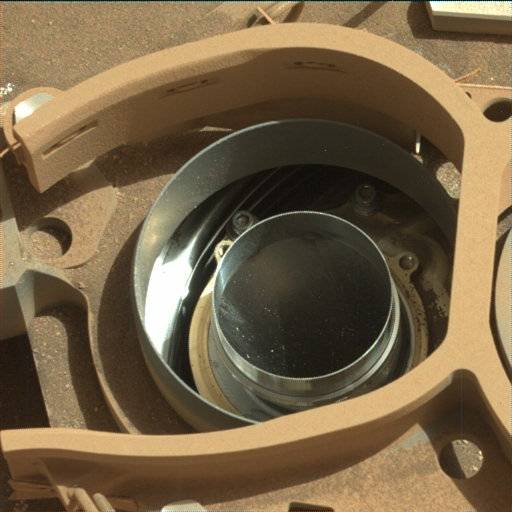
This image from NASA’s Mars rover Curiosity shows the open inlet No. 2 on the rover’s SAM (Sample Analysis at Mars) instrument suite, where Curiosity delivered a sample from the “Kings Canyon” drill hole, for study using SAM’s Evolved Gas Analysis (EGA) mode. This image was taken by Mastcam Right (Mast Camera) aboard Curiosity on sol 4270 — Martian day 4,270 of the Mars Science Laboratory mission — on Aug. 10, 2024 (at 14:16:21 UTC).
NASA/JPL-Caltech/MSSS
Earth planning date: Monday, Aug. 12, 2024
The SAM EGA over the weekend was successful, and that means we’re well on our way to planning the GCMS (Gas Chromatograph Mass Spectrometry) on our “Kings Canyon” drill sample! GCMS is an energy-intensive activity, so we’ll be using today’s two-sol plan mainly for recharging our battery and prepping SAM by cleaning its GC column with high temperatures (like you’d clean your own oven!). We can still afford about 75 minutes of remote sensing over both sols this plan and are using it for our usual ChemCam, Mastcam, and Navcam activities.
On the first sol, ChemCam is kicking things off with a LIBS (Laser Induced Breakdown Spectrometer) on “The Major General” — some crunchy light-toned bedrock about 9 feet away (about 2.8 meters) — then will capture a long-distance 10-frame RMI of the Gediz Vallis channel floor to the south. Mastcam finishes off the first sol’s 72-minute science block with an M100 image of The Major General LIBS spots and a 68-frame stereo mosaic of the midfield terrain to fill in what’s left of the midfield with M100. We’ll nap until about 15:15 local Mars time, when we’ll wake back up to take just two M100 images near the RSM hardstop at the same timing as a previous mosaic to make sure we have continuous coverage across the hardstop. SAM’s GC column clean is planned between 21:00 and 01:00; overnight between our two sols.
On the second sol, we’ll have our second remote sensing block around 11:00 for 73 minutes. ChemCam is planning a second LIBS target on “Dewey Point” — a slab of light-toned bedrock about 13 feet away (about 3.9 meters) — a passive-spectrum observation of a dark float block named “Waller Minaret,” and another long-distance four-frame RMI of southern Kukenan butte to the southeast. Mastcam has just a single M100 image of Dewey Point’s LIBS spots this sol so that Navcam can complete some environmental movies to hopefully capture some dust devils and maybe even some clouds!
Written by Natalie Moore, Mission Operations Specialist at Malin Space Science Systems
Share
Details
Last Updated
Aug 14, 2024
Related Terms
Blogs
Explore More
2 min read
Sols 4275-4276: A Familiar View
Article
34 mins ago
2 min read
Sols 4270-4272: Sample for SAM
Article
2 days ago
2 min read
Sols 4268-4269: Admiring Kings Canyon
Article
3 days ago
Keep Exploring
Discover More Topics From NASA
Mars
Mars is the fourth planet from the Sun, and the seventh largest. It’s the only planet we know of inhabited…
All Mars Resources
Explore this collection of Mars images, videos, resources, PDFs, and toolkits. Discover valuable content designed to inform, educate, and inspire,…
Rover Basics
Each robotic explorer sent to the Red Planet has its own unique capabilities driven by science. Many attributes of a…
Mars Exploration: Science Goals
The key to understanding the past, present or future potential for life on Mars can be found in NASA’s four…

 English