Curiosity Navigation
Curiosity Home
Mission Overview
Where is Curiosity?
Mission Updates
Science
Overview
Instruments
Highlights
Exploration Goals
News and Features
Multimedia
Curiosity Raw Images
Images
Videos
Audio
More Resources
Mars Missions
Mars Sample Return
Mars Perseverance Rover
Mars Curiosity Rover
MAVEN
Mars Reconnaissance Orbiter
Mars Odyssey
More Mars Missions
The Solar System
The Sun
Mercury
Venus
Earth
The Moon
Mars
Jupiter
Saturn
Uranus
Neptune
Pluto & Dwarf Planets
Asteroids, Comets & Meteors
The Kuiper Belt
The Oort Cloud
3 min read
Sols 4266-4267: Happy ‘Landiversary,’ Curiosity
Earth planning date: Monday, Aug. 5, 2024
After the usual morning routine of doing some engineering housekeeping, Curiosity continues to take some remote science observations. We take a ChemCam LIBS observation and a Mastcam image of the “Peeler Lake” target, a dark, nodular target that appears to be more erosion-resistant than nearby rocks. By comparing Peeler Lake to “Kings Canyon” (which also has some nodules), the science team may be able to determine more about their relative compositions. ChemCam also takes RMI images of the Kings Canyon drill tailings. There is also a ChemCam RMI mosaic of Gediz Vallis and a Mastcam of the “Sky High Lake” target, which is a rock with a gray coating. The last thing in this science block is an image down the CheMin inlet before we deliver sample to the instrument. After a long nap, in the late afternoon we have the first part of a large Mastcam mosaic of “Milestone Peak” channel deposits and we add some more frames to our ongoing 360-degree panorama. This late afternoon lighting helps highlight layers and textures. We also have our normal DAN and REMS observations throughout the plan.
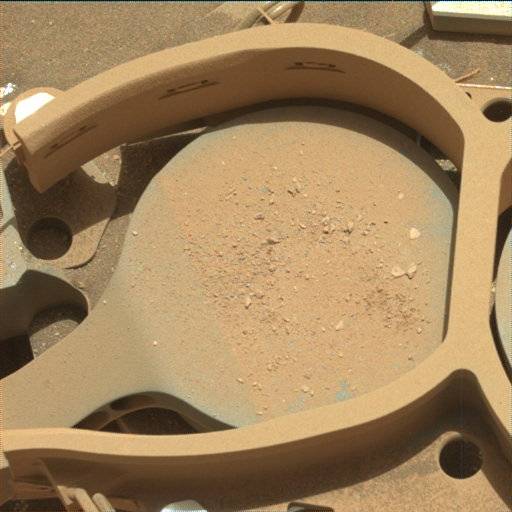
After another nap, Curiosity wakes up to deliver sample to CheMin. We do this by pointing the drill bit over the open CheMin inlet and using a tiny bit of percussion and rotation to release some sample from the drill. We do this late in the afternoon to reduce the time between delivering the sample and starting the analysis (which has to happen in the cooler temperatures of nighttime) to minimize the degradation of the sample. After allowing CheMin to analyze the sample for most of the night, Curiosity wakes up and dumps out the sample to avoid it sticking too much inside the instrument.
On the second sol of the plan, Curiosity is taking more remote-sensing observations. Navcam atmospheric dust observations kick off first. ChemCam then takes a LIBS observation of “Sky High Lake” followed by RMI images inside the drill hole (to take a look at the interior layers of the rock) and Gediz Vallis. Last in this morning block, there are Mastcam images of Sky High Lake and a post-dropoff image of the open CheMin inlet to look for any sample that may be stuck there. In the late afternoon, we finish up the Milestone Peak mosaic.
Written by Ashley Stroupe, Mission Operations Engineer at NASA’s Jet Propulsion Laboratory
Share
Details
Last Updated
Aug 07, 2024
Related Terms
Blogs
Explore More
3 min read
Sols 4263-4265: A Royal Birthday Celebration at Kings Canyon
Article
2 days ago
2 min read
Sols 4261-4262: Drill Sol 1…Take 2
Article
7 days ago
3 min read
Sols 4259-4260: Kings Canyon Go Again!
Article
1 week ago
Keep Exploring
Discover More Topics From NASA
Mars
Mars is the fourth planet from the Sun, and the seventh largest. It’s the only planet we know of inhabited…
All Mars Resources
Explore this collection of Mars images, videos, resources, PDFs, and toolkits. Discover valuable content designed to inform, educate, and inspire,…
Rover Basics
Each robotic explorer sent to the Red Planet has its own unique capabilities driven by science. Many attributes of a…
Mars Exploration: Science Goals
The key to understanding the past, present or future potential for life on Mars can be found in NASA’s four…

 English